
Security and Stability
- The Russian tanker damaged in a series of explosions, which has been drifting in the Mediterranean Sea for the past two weeks has entered Libya’s search and rescue zone. The House of Representatives’ Defense and National Security Committee issued a statement concerning the security implications of the Russian gas tanker that drifted off the city of Zuwara. The committee affirmed that this incident is not merely an environmental threat. It also constitutes a blatant violation of Libyan national security. It raises serious questions about protecting national sovereignty. They also concern combating maritime terrorism in territorial waters. The committee emphasized in its statement: Protecting Libyan sovereignty over its territorial waters and airspace is a red line. It affirmed that any military or security operation within this area is a violation. Such an operation without prior coordination and approval from competent Libyan authorities is unacceptable. It is considered a blatant violation of international and national laws.
- A comprehensive investigative report recently released by the “Sahara Intelligence” platform has uncovered a systemic and organized citizenship forgery crisis in Libya, revealing profound structural breaches within the state’s national identity infrastructure. The report is based on a rigorous analytical consolidation of 54 official publications issued by the Office of the Attorney General of Libya between late 2024 and March 2026.
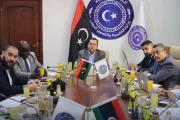
- Minister of Interior Major General Issam Abu Zriba discussed the security situation in the Southern Region. He addressed the field challenges faced by security directorates. This discussion took place during a meeting. The head of the Ministry’s Office in the Southern Region participated. Directors of security from Sebha, Ghat, Al-Jufra, Ubari, and Al-Shati attended. The Director of Supply Affairs and the Director of Financial Affairs were present. The Deputy Director of Al-Jufra Security and the Assistant for Public Affairs at Ghat Security Directorate also joined. The meeting reviewed security arrangements. These arrangements aim to develop the work of the directorates. The latest security developments in the region were monitored. Ways to address operational difficulties were discussed. Coordination mechanisms between ministry components were examined. Activating field plans was also a key topic. This ensures a rapid response to security requirements.
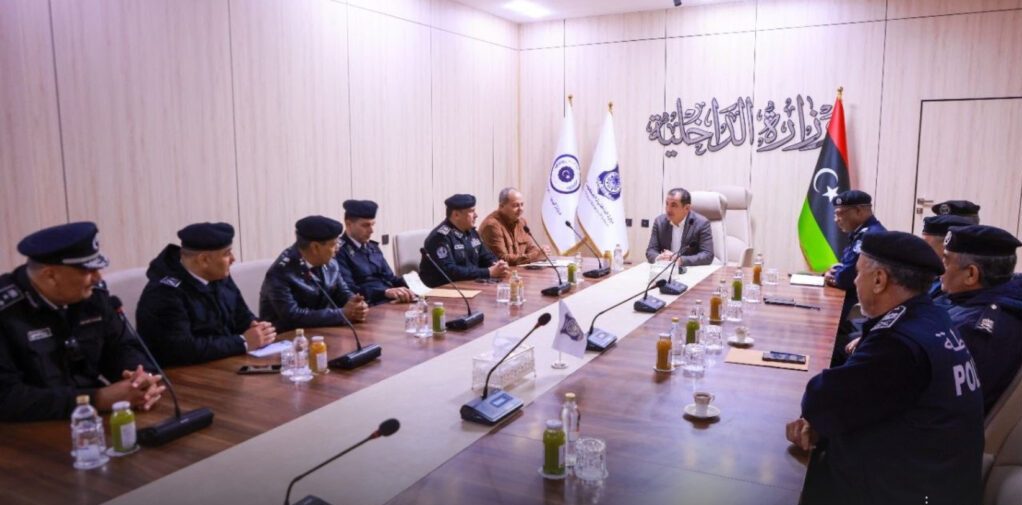
- The Minister of Interior in the Libyan Government, Major General Essam Abu Zriba, held an extensive security meeting. He met with the Head of the Ministry’s Bureau in the Southern Region. Directors of security directorates from Sabha, Ghat, Al-Jufra, Ubari, and Al-Shati were also present. The Director of Supply Affairs and the Director of Financial Affairs attended. The Deputy Director of Al-Jufra Security and the Assistant for Public Affairs at Ghat Security Directorate participated. They discussed the security situation and field challenges in the region. The meeting reviewed security arrangements. These arrangements aim to improve the work of security directorates. Updates on the security situation in the Southern Region were discussed. Ways to address operational difficulties were also covered. Coordination mechanisms among ministry components were examined. They also focused on activating field plans. This ensures a rapid response to security requirements.
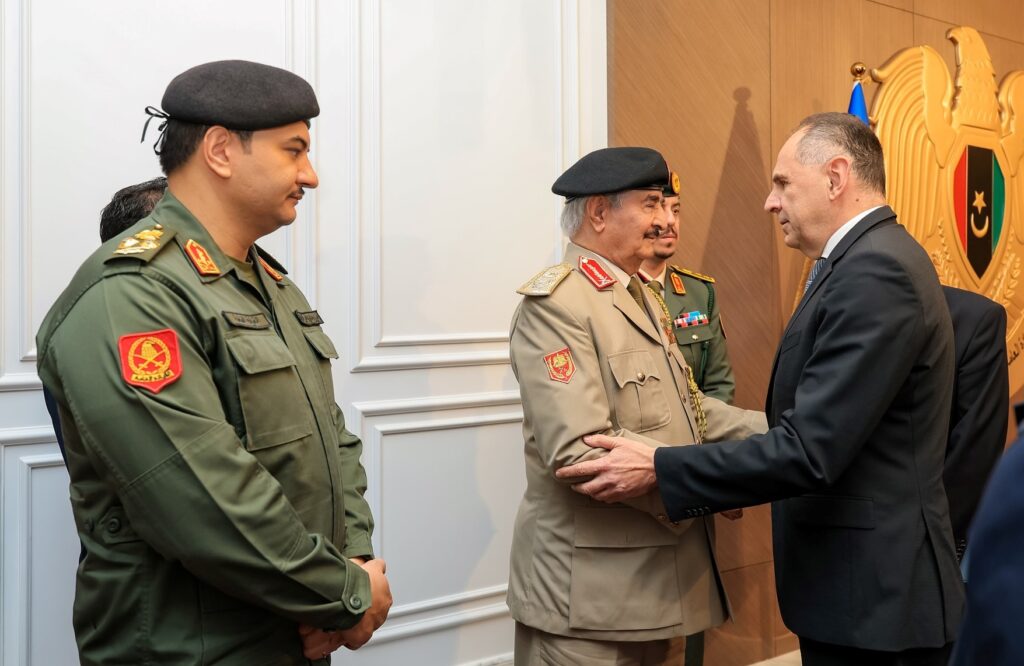
- The Commander-in-Chief of the Armed Forces, Field Marshal Khalifa Haftar, received the Minister of Foreign Affairs of Greece, Mr. George Gerapetritis, and his accompanying high-level delegation. The meeting took place in the presence of the Deputy Commander-in-Chief of the Armed Forces, Lieutenant General Saddam Haftar. During the meeting, the Commander-in-Chief welcomed the Greek delegation, emphasizing the depth of the historical and economic relations linking the two neighboring countries. He highlighted the importance of these ties across various economic, cultural, and educational fields. They discussed enhancing academic cooperation between Greek and Libyan universities, specifically the University of Benghazi. He also stressed the importance of developing trade exchange and opening maritime lines to facilitate the transport of goods and commodities between the two nations. The two sides concluded by discussing the importance of coordination and cooperation in combating illegal migration. Both parties agreed that such collaboration serves the mutual interests of both countries and the stability of the region in general.
Governance, Economy, and Politics
- Former General National Congress member Abdul Monem Al-Yassir stated that the conflict in Libya is no longer only political or military. It has also become a war over information. It is a war over people’s perception of reality. He believes misleading information can sometimes be more impactful than traditional weapons. Al-Yassir explained the spread of forged data serves several main objectives. These include disrupting the political scene. They also aim to fuel conflicts between rival parties. Another goal is undermining the credibility of institutions. Sometimes, it involves testing reactions to potential political scenarios.
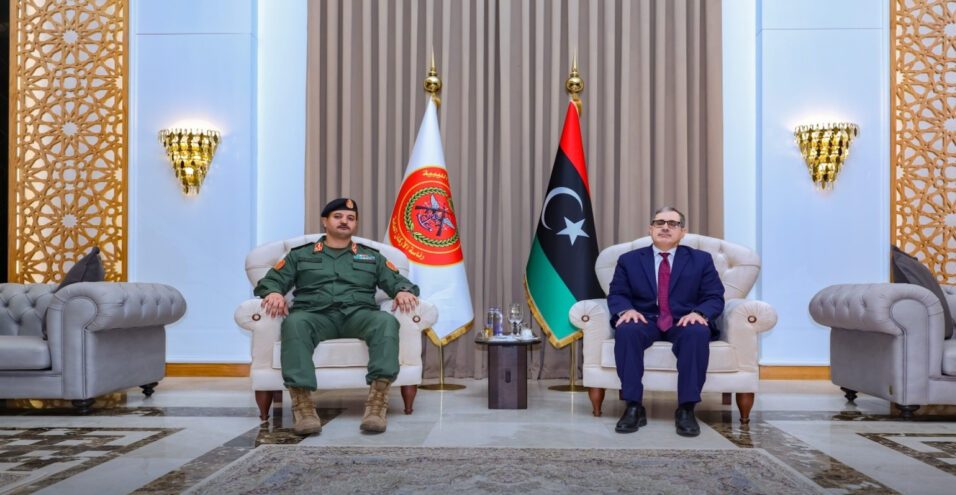
- The Chief of Staff of the Armed Forces, Lieutenant General Khaled Khalifa, received Jeremy Brent, the Chargé d’Affaires of the US Embassy in Libya. They discussed several joint cooperation files focused on military and security cooperation. They also explored ways to develop this cooperation. The goal is to serve mutual interests. The meeting also addressed recent regional and international developments. The two sides exchanged views on several issues of common interest. Both sides affirmed the importance of continued coordination. They also stressed the need for ongoing communication.
- Mansour Al-Hassadi, member of the High Council of State, affirmed that the Central Bank’s responsibility to protect public funds has doubled. This is due to the governmental division. It is also due to the absence of a budget law. He said the Central Bank must disburse allocations totaling $200 million. This must follow national and professional procedures. He called for the disbursement process to be transparent. It should be free from any favoritism. He noted the goal of these allocations is to ease the suffering of citizens. He emphasized the importance of ensuring these funds are not exploited. They must not be misused or embezzled by corrupt government entities.
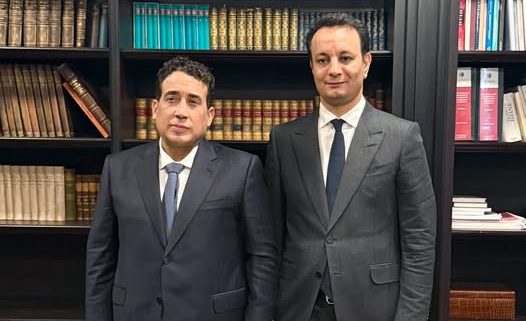
- The Head of the Presidential Council, Mohamed Al-Menfi, met with Belqasim Khalifa, Director General of the Libya Development and Reconstruction Fund. The meeting addressed updates on the reconstruction file. Participants affirmed the strategic importance of development programs. These programs are a fundamental pillar. They are essential for achieving stability. They also reinforce state unity. Al-Menfi praised the Fund’s role in reconstruction and development. He valued the efforts made in Derna. These efforts address the aftermath of Cyclone Daniel. The reconstruction file shows progress. It includes project implementation and infrastructure rehabilitation.
- The Supreme Court’s Constitutional Circuit in Tripoli issued a ruling. It declared four parliamentary laws unconstitutional. These laws relate to the judicial authority system. This ruling continues to impact Libya’s judicial and political scenes. Debate is growing over the limits of jurisdiction. It also concerns the unity of the judicial institution. The decision’s implications for justice in the country are also being discussed. Legal and judicial circles did not view it merely as a constitutional ruling in a legal dispute. They saw it as a critical juncture. It concerns one of Libya’s most complex issues. This is the judiciary’s position within the political division. It also addresses the impact of judicial rulings on institutional balance.
Economy and Energy
- Engineer Balqasim Khalifa, Director General of the Libya Development and Reconstruction Fund, emphasized during his Eid visit to the Projects Management headquarters, the accelerating project completion. He also stressed expanding project scope that will boost reconstruction efforts and support future development plans. Hatem Al-Oraibi, the Director of the Department, welcomed him. Engineering, technical, and administrative teams were also present. Engineer Balqasim affirmed the progress made since the projects began. He stated it forms a solid foundation calling for improved execution efficiency and adherence to quality standards is crucial.
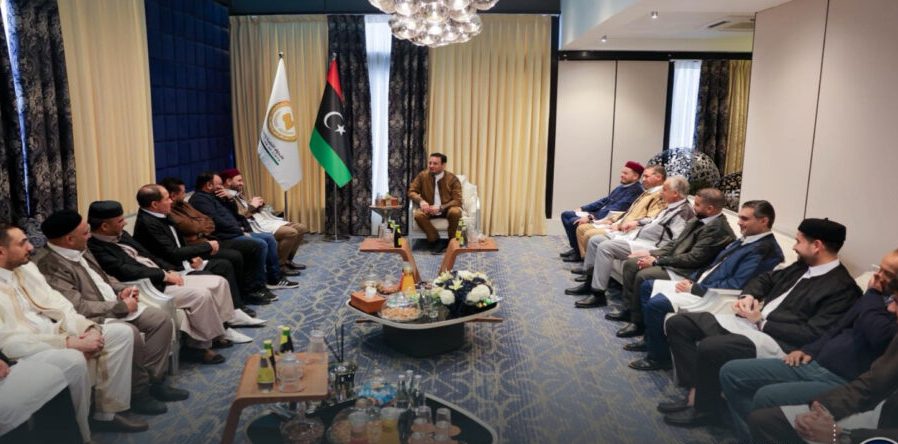
- The “Green Sustainability” initiative has concluded its work. This followed a year of activities and programs. A virtual session reviewed key results and recommendations. The next phase will focus on practical applications and operational policies. Wael Al-Ushaibi, the initiative’s supervisor, stated that the initiative emerged from growing environmental and climate change concerns. It aimed to create a dialogue space. This space brought together decision-makers, experts, researchers, and civil society organizations. The initiative was implemented in cooperation with ACTED. It lasted for over a year. It organized workshops and seminars. These events were held both in-person and virtually. Locations included Benghazi, Al-Bayda, and Sabha. They addressed priority environmental issues. These included climate change and water resources. Agriculture, the blue economy, and urban planning were also covered.
- Ahmed Al-Oraibi, the Media and Public Relations Director at the Arabian Gulf Oil Company, confirmed that the J22 gas utilization project training program is on schedule. The first and second groups finished their training. The third and final group has now started. Al-Oraibi clarified the project’s scope. It is not just a technical file. It is part of a wider vision. This vision aims to improve resource exploitation efficiency. It focuses on better resource management. Gas, in particular, has needed serious attention for years. The project also emphasizes reducing gas flaring. This has environmental benefits. It also recovers a wasted resource. This transforms it into productive and economic value. The sector seeks practical solutions to reduce waste. It also aims to boost operational efficiency.